

All business-customer relationships are transactional in nature. Yet, we make many emotional decisions when choosing who we can trust. We need shortcuts to make those decisions quickly and not spend too much energy on brain activity. Enter Brand archetypes, a powerful tool that taps into our deepest emotions and gut feelings, guiding us swiftly and confidently toward
brands that resonate on a human level.
Why Humanizing Brands Matters
At the heart of every brand-customer interaction lies a fundamental truth: we connect with personalities, not just features or benefits. Humanizing your brand through a personality archetype isn’t just helpful; it’s essential. These archetypes forge powerful connections as they tap into universal human experiences and emotions. They make your brand not only seen but felt.
Brands built around a strong archetypical image are more likely to have clear messaging so let’s see the how and why of the Brand archetype paradigm.
The fascinating story of brand archetypes
The concept of brand archetypes finds its roots in the works of Carl Jung, a Swiss psychiatrist and psychoanalyst. Jung identified 12 primary archetypes, which he believed represented fundamental aspects of human personality – universal across almost all cultures.
Jung’s work can be linked to astrology and the zodiac. For Jung, astrology is the summation of all ancient knowledge of psychology. The zodiac classifies individuals based on their birthdate, but we use brand archetypes to classify brands based on their unique qualities and values. By applying these archetypes, marketers can effectively create a more human-like image of their brands.
Navigating the delicate balance between science and mystique, let’s unveil your brand’s zodiac sign.
One of the most exciting processes, when I work with clients, is the exercise in which we try to uncover which archetype aligns best with their brand’s vision. At the end of this article, we’ll explore how you can facilitate this discussion with your team.
Meet the 12 archetypes
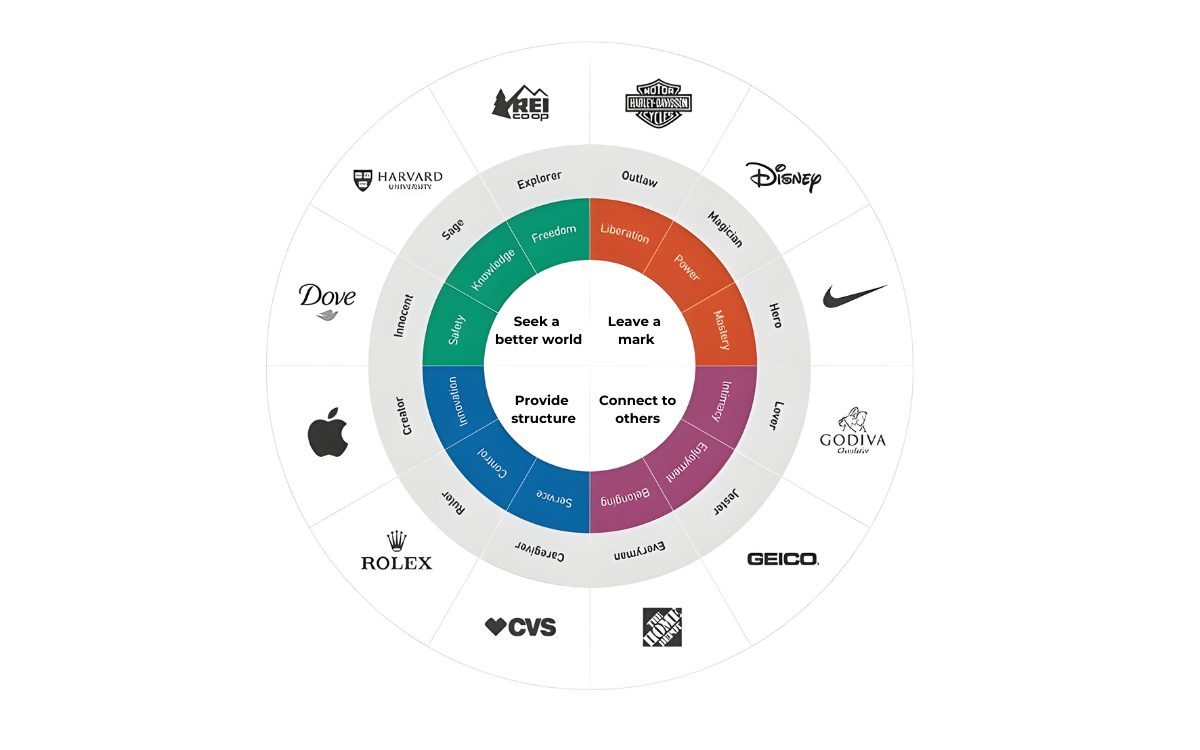
- Innocent: pure, simple, optimistic.
- Sage: wisdom and knowledge at its finest.
- Explorer: adventurous, spirited, boundless.
- Outlaw: breaking the norms, daring to be different.
- Magician: master of mystery and transformation.
- Hero: courageous, bold, battling for greatness.
- Lover: pleasure, indulgence, love.
- Jester: living for laughter and light moments.
- Everyman: approachable, dependable, community-building.
- Creator/Artist: imagining and innovating without bounds.
- Ruler: commanding respect and authority.
- Caregiver: empathizes, helps, and protects others.
Brand archetypes can be grouped into four main families. Let’s explore them and see what they represent.
The first group is the freedom-motivated brands. These brands are driven by the will to surmount any boundaries.
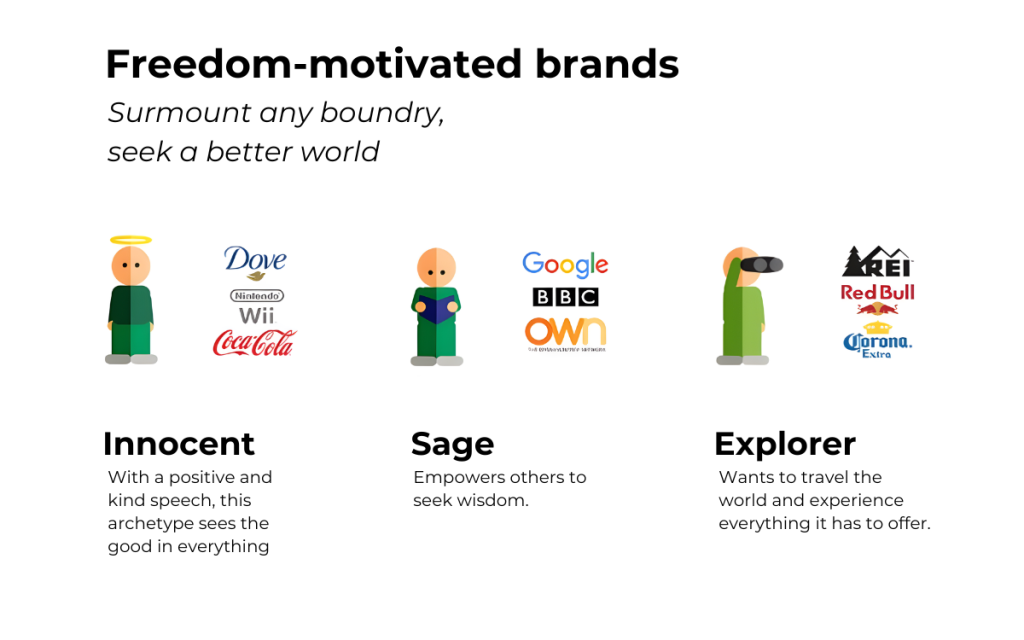
- Innocent. The guiding principle of the innocent archetype can be encapsulated in the phrase “Free to be you and me” mirroring their foundational beliefs in simplicity, purity, and boundless optimism. Those who embody the innocent archetype aspire to preserve a sense of innocence and purity, often holding the belief that life can be led with grace, free from unnecessary complexities and negativity.
Brands: Dove, McDonald’s, Innocent, Coca-Cola, Volkswagen.
- Sage. Harnessing knowledge as a pathway to liberation, Sages are dedicated to accumulating a wealth of information and pursuing wisdom. They are thoughtful and analytical. They do not look to change the world themselves but prefer to empower others to do so by seeking out valuable information and sharing it. They are often life-long learners and thought leaders and make excellent mentors. “The truth will set you free.”
Brands: TED, Google, BBC, Discovery Channel, The Times.
- Explorer brands are driven by the desire for freedom and independence. They set out without a clear path and are always open to novelty and adventure. Explorers are seeking out new things, new places, and new experiences. They are on a continuous journey of discovery. “Don’t fence me in.”
Brands: NASA, Jeep, The North Face, Subaru, National Geographic.

In the second category are the ego-motivated brands. These are the brands motivated by the meaningful impact they want to have on the world.
- Outlaw – challenging the status quo. Outlaws are ready to disrupt and shock, they are rebellious and wild. They actively seek to rip up the rule book and dismantle existing paradigms. The Outlaw is happy to take risks to create something unique and inspiring. They see themselves as free thinkers. They are not appealing to all and often create a cult-like following inspiring very strong brand loyalty amongst a smaller close-knit audience. “Rules are made to be broken.”Brands: Harley-Davidson, Uber, Diesel, Greenpeace, Red Bull, Oatly
- Magician – Magicians understand the laws of the universe better than anyone and they can make the impossible possible. The Magician brand archetype embodies a visionary who wants to dazzle their audience with new and exciting experiences transforming dreams into tangible experiences. They like to take their followers on a mystical journey and give them magical moments that stick in their memory. Magicians savor knowledge but prefer to use it to realize their vision rather than share it directly with the world. “I make things happen.”
Brands: Disney, Dyson, TUI, Polaroid, MAC Cosmetics.
- Hero. On a quest for excellence and dedicated to leaving a mark on the world, heroes are competent, courageous, bold, confident, and inspirational. Their moral compass points towards righting wrongs and effecting positive change in the face of adversity. They have a core desire for mastery and inspire others to push themselves. Hero brands portray success through tenacity, hard work and effort and meet challenges head-on. They are proud that their work sets them apart and see their work as essential and empowering. “Where there’s a will, there’s a way.”
Brands: Nike, BMW, FedEx, Adidas, The Royal Marines.
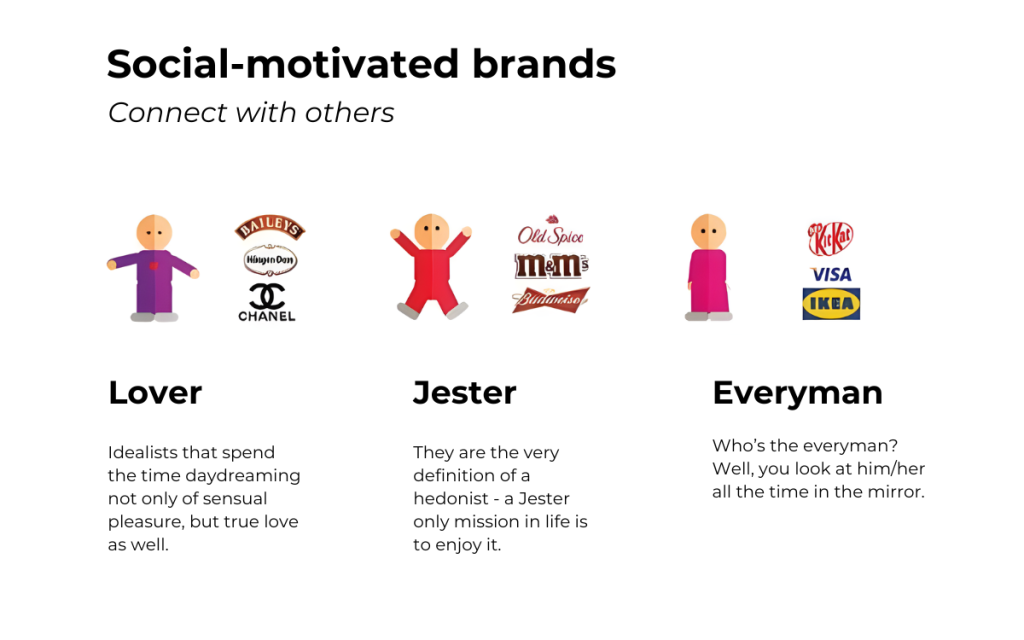
The third category contains the social-motivated brands. They try to connect with others and connect others among themselves. These are often brands that build a sense of unity, community, and shared values.
- Lover – focused on creating intimacy. They are looking to create a relationship and connect through sensual pleasure. They are passionate, intimate, warm. Brands are often sensual and empathetic, motivated to become more emotionally and physically appealing to their audience. They may also embody qualities of spirituality, companionship, and a strong focus on family values. “You’re the only one.”
Brands: Victoria’s Secret, Godiva, Anne Summers, Alfa Romeo, Chanel.
- Jester – driven by a having-a-good-time vibe. Jesters live in the moment, they are mischievous, hedonistic, light-hearted. The Jester wants to make people laugh and bring light-heartedness to all that they do. Jester brands maintain a playful stance and see good in every situation.“You only live once.”
Brands: Budweiser, Skittles, Old Spice, M&Ms.
- Everyman – creating a sense of belonging. They want to build solid virtues. They are supportive and faithful. Everyman brands are unpretentious, relatable and approachable. They strive to create deep connections with people and long to be liked by all. They are often quite generalized and are driven by a core desire for community and belonging. They hate to stand out and don’t display any extremes of character or opinion preferring to be inclusive. “All are created equal.”
Brands: Ford, Levis, Ikea.
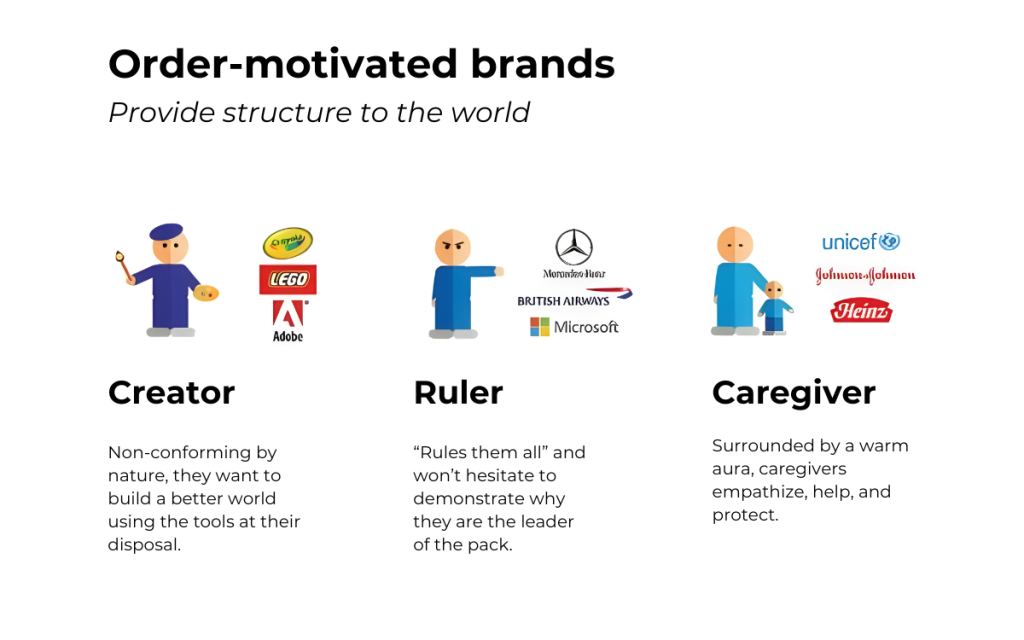
The last is the category of order-motivated brands. These are brands that try to provide structure to the world.
- Creator – driven by innovation. Creators want to create things of enduring value. They are creative, imaginative, inventive, and non-conformist. Creators empower others to think creatively and express themselves through the products they produce and the experiences they create. “If you can imagine it, it can be done”.
Brands: Apple, Lego, Adobe, GoPro, Crayola
- Ruler a dominant personality with a drive for power and control. A natural leader, the Ruler is responsible and organized. Rulers are often exceptionally confident, proud of their expertise, and possess strong leadership skills. They are a pillar of trustworthiness with their stable personalities. “Power isn’t everything, it’s the only thing.”
Brands: Microsoft, Rolls Royce, Rolex, Hugo Boss.
- Caregiver – wanting to be of service, protect and care for others. They are maternal, nurturing, selfless, and compassionate. They want others to feel secure and will defend those who are less fortunate than themselves. Caregivers are often maternity figures. “Love your neighbor as yourself.”
Brands: Unicef, Johnson & Johnson, NHS, Pampers, Volvo.
Engage and Excite: Choose Your Archetype with Fun and Purpose
Selecting your brand’s archetype is not just a decision; it’s an adventure. Why not turn it into an engaging workshop? It’s a lot of fun too and the brand teams get very excited by these discussions. Here’s a step-by-step guide for your workshop:
- Start by providing the participants with information about the brand archetypes before the workshop.
- When you gather, describe again the categories and quickly remind them of the archetypes. Give everyone some time to think about the main archetype of your brand and 1-2 additional supporting ones.
- Ask everyone to share what they think – which archetype they picked for the main one and which are the supporting ones. Encourage open discussion and debates about the selected archetypes, and make sure everyone shares their thoughts, perspectives, and concerns. This is probably the most important step because it’s the moment you align your thoughts which is more important than just picking an archetype.
- Finally, after thorough discussion and analysis, choose one primary archetype that aligns best with your brand’s values, purpose, and target audience. You can also select one or two secondary archetypes that complement the primary one, adding depth just like with real people.
A defined brand archetype has many benefits and can significantly improve your team’s alignment. Breathe life into your brand by discovering its archetype. Let’s connect and craft a vibrant identity that your customers can’t help but be drawn in. Call me, and let’s start this exciting journey together.

