

In this age of noise and information overload, the question isn’t merely about what your brand says but how it says it. Yet the Brand Tone of Voice (TOV) concept is often overlooked although it provides multiple benefits which is why it’s worth spending time to discuss, define, and refine it over time.
The way your brand communicates — the words you choose, the style you adopt, the emotions you convey — is more than just a part of your branding. It is the representation of your identity.
In this article, we will delve into why your Brand TOV is crucial, how you can uncover your unique voice, and, most importantly, how to apply it. Whether you’re a startup finding your identity or an established business looking to revisit the branding basics, understanding, and harnessing the power of your Brand TOV is the key to making your message heard and remembered.
What is the tone of voice of a brand?
As people, we all talk in a way that reflects who we are. We all choose every word we say or write – consciously or not. Those words are an externalization of everything that lies beneath the surface: what we believe, our heritage, who we’re talking to, what we want, our hopes and dreams. Brands (can) do the same and you have probably heard about or discussed your brand archetype which is the image encompassing your brand. If the archetype helps define your brand’s character, the voice helps to convey that character through your communication in your day-to-day work.
Brand tone of voice is not so much about what you say to your audience, but more about how you say it. It’s the personality, mood, and emotion you convey through your word choice and writing style. And it can have a huge impact on how your brand is perceived.
Even if you haven’t thought about it before, when you read something from a brand you know, you have certain expectations of how they speak. Even a simple greeting can seem in or out of line with a brand’s communication. Think of the brands Virgin, Oatly, Mailchimp, and IBM and try matching them with these greetings: “Hi”, “Hiya”, “Hello”, “Sup”, “Yo”. Does the answer immediately pop up?
Your tone of voice is an expression of your brand’s beliefs, values, and personality. It’s the foundation of your brand’s verbal identity and should shine through your copy, your content, and your customer service.
What are the benefits of defining and using your TOV?
- Clarity and meaning. In face-to-face communication, it is somehow easier for us to sense what the right tone is in each situation, in each conversation. However, brands usually don’t have that luxury, and their communication is mostly written. That is why it’s crucial to have a set of rules to follow so that everyone involved in content creation, or customer service can get the logic behind the voice. Having a defined brand voice is the next best thing to face-to-face communication.
- Speaks to emotions. Buying decisions are made on feelings first, and facts second. We’re drawn in by brands who speak to us on an emotional level, and we turn on our confirmation bias to justify the purchase later using logic and reason. People will remember how your brand makes them feel and if they don’t feel anything, they will forget it.
- Builds trust. Liking your brand is the first step for someone to trust it, but to stay loyal customers need to consistently have the same experience. That is how they begin to build a relationship with that brand. And just like in any relationship, the sense of familiarity strengthens the bond. You can’t build a relationship with someone who talks in a way that’s inauthentic, or inconsistent.
- Strengthens your brand. We are more used to seeing consistency in the colors and visuals of a brand and the TOV is as important and should be synchronized. A distinctive tone of voice used consistently in every touchpoint can become as recognisable as your colours or imagery and will help reinforce the other aspects of your brand.
- Makes it memorable. Being “nice” is great. But it’s a word we usually use to describe someone who, despite being polite, friendly and forthcoming, didn’t leave a lasting impression. The same goes for brands. You don’t have to be the ‘rebel’ brand to be memorable – but you have to be distinctive. That being said, we do not all need to be the Oatly, Nike, or Mailchimp of our industry, it just means that we have to make deliberate choices to showcase our brand’s uniqueness.
- Helps customers categorize you. When a brand tries to appeal to everyone, they end up making it difficult for customers to ‘get’ who they are for. The more you get to know a brand through its copy, the more you understand who the team behind it is, what they stand for, and their unique place in the world. And if you are afraid of losing customers who will not feel that you are right for them, it may sound a little contra intuitive but the opposite is true, the more distinct you are, the more the right people will like and remember your brand and will be able to recall it when they need your services.
- It underpins workplace culture. Brands that treat their employees with the same respect as their customers perform well. The tone of Voice can be a tool to unify teams around a sense of shared purpose. Improve the sensitivity to language, and you’ll improve your company’s performance. Improved communication through consistency helps employees have more clarity which in turn helps them work more effectively. I strongly believe that a good workplace culture can help have a distinct TOV but the opposite is also true: a considerate TOV can also have a significant impact on your culture and make your employees happier and less likely to leave.
Developing your tone of voice
Now that you know what it is and why you need it, you are probably already wondering how to develop your brand TOV.
Start with research
You already know your brand very well but maybe you didn’t articulate the TOV before, so you don’t know where to start. In the picture below you can see different sources that can get you inspired and help you clarify how you want your brand to sound and how you definitely don’t want it to sound.
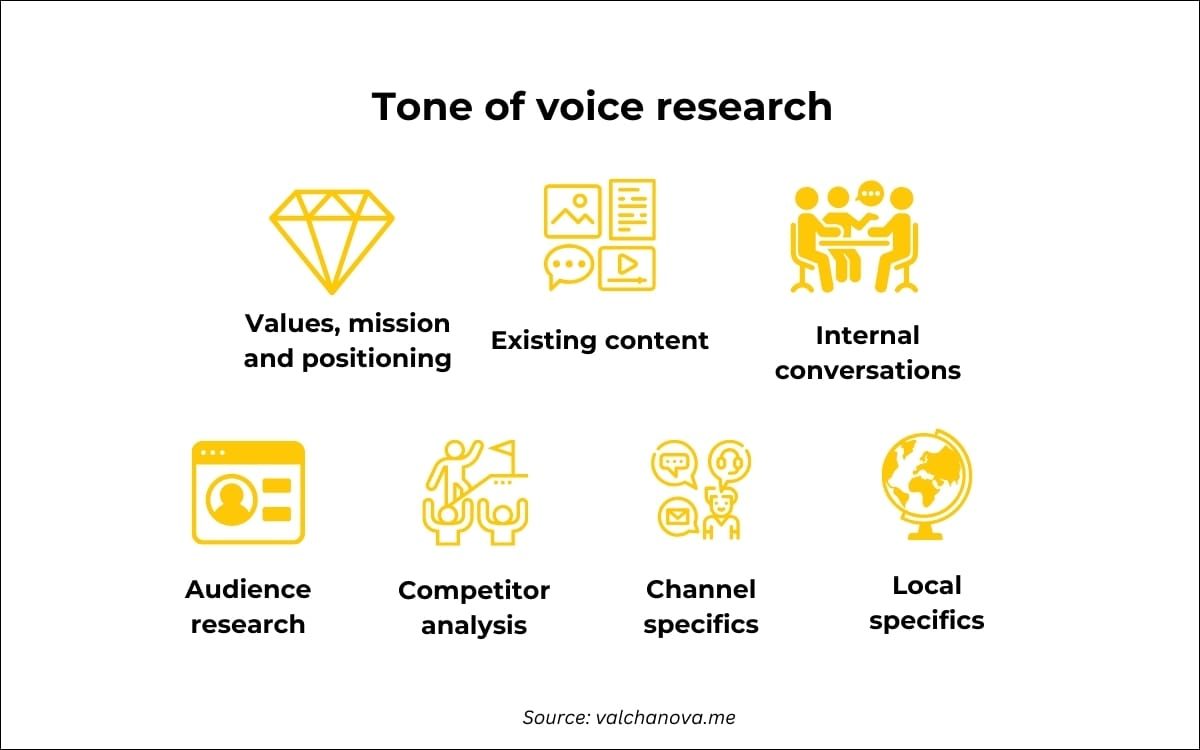
First, we start from the inside out.
Values, mission and positioning. It’s important to think about how your voice will reflect what your brand is trying to achieve in this world. As an example, think of Patagonia, as a cause-driven brand. Their voice reflects very well their values, it’s honest and bold, it sounds almost like Yvon Chouinard himself.
Start by defining your values and how they will be reflected in the voice:
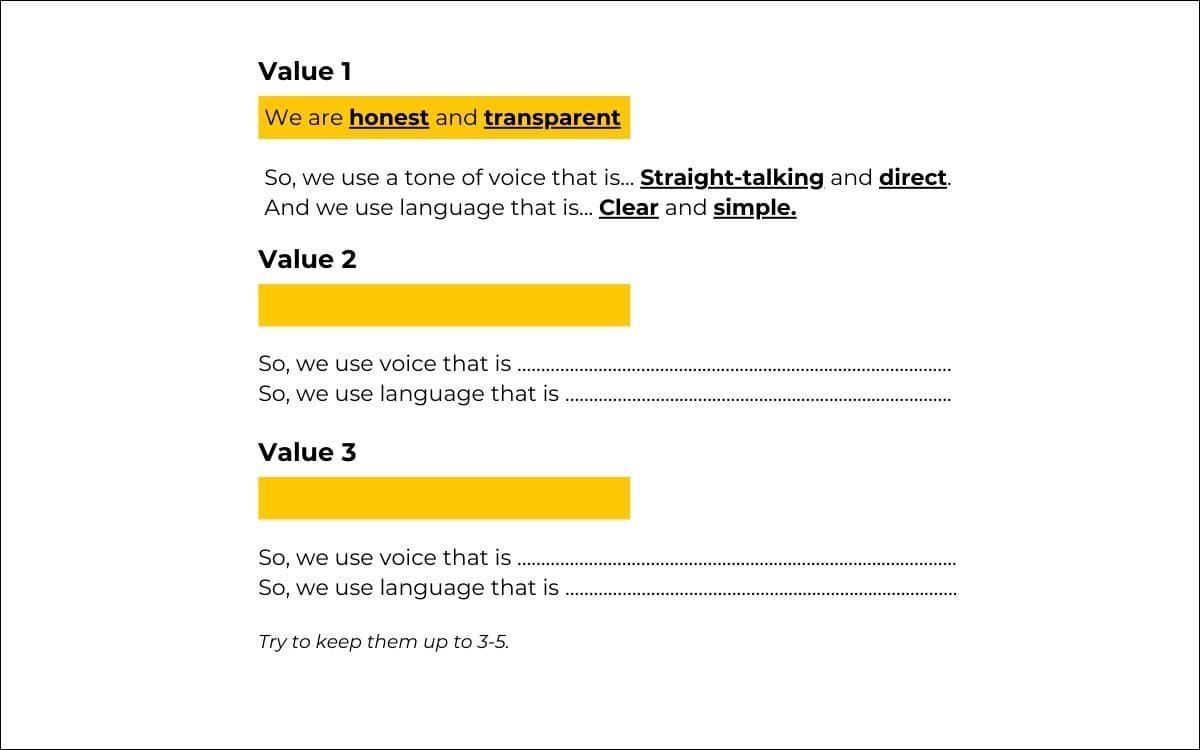
When listing your values it’s important to prioritize and reduce them as much as you can. If you have more than three values – try to reduce them to three most important and then underline a single most important one. If you stay with many, you will face the problem that anything would sound on brand later, so do this work at the beginning to make it easier for you later.
Existing content. Even if you haven’t thought in a structured way about your brand voice if you have created communication for a while, you already have existing materials to look at. Check the direction you have intuitively chosen – do you speak more formally, or more friendly? Are you using humor and what kind of humour is it? Try to figure out which parts of the communication you like and which ones you would change.
Internal conversations. This is the part related to your company culture, check how you already speak to each other – in your internal messaging platforms, emails, face-to-face communication. This style could help you create your brand style of communication more easily as it will come more naturally to you.
We then move on to the external factors of the bigger picture that may help you decide how you want your brand to sound.
Audience research. Think about the ambitions, needs, and wants of your customers, and how they speak to each other. You would speak differently to an audience of foodies in search of the next great taste as compared to moms of newborn babies. What if you have both personas in your audience? You will adjust your tone accordingly the same way we as people change our tone according to the situation. You would explain the same thing differently to your best friend and to your boss, right? But you are still the same person. Aligning your general TOV with your audience is one of the most important considerations. If you serve different audiences, it’s better to prioritize the main one to develop your voice. Then case by case you will decide if you need to modulate the tone to fit the message better.
Competitor research. It’s important to have a look at your competitors for several reasons. First, you don’t want to sound exactly like any other brand. Second, looking at examples makes it easier to decide what you like and what you don’t like in the communication so you can then define your own space. It may be a good idea to look at other industries as well for inspiration and try to think in terms of “we are the Mailchimp of food delivery” for instance.
Channel specifics. Check your main communication channels; they can help you define your brand voice. If you use multiple channels, it doesn’t mean you need to sound completely different on each one. Instead, it’s like maintaining the same main character and voice while adjusting the tone as needed in various situations. I prefer to approach it from a “message over the medium” perspective, meaning you adjust the tone based on the topic, regardless of the channel. However, if your primary channel is TikTok and your supporting one is Instagram, you should think about these small adjustments more carefully. In such cases, it’s often helpful to revisit the audience analysis.
Local specifics. If you’re an international business, consider whether you need to adapt your tone to reflect local cultures in different countries. While in the US positive, upbeat and direct communication is well accepted, in Europe sometimes it’s better to be a little more formal, and in Asia directness can be seen as impolite.
Exercises to help your team develop the brand voice
After preparing your research, you can gather your team and make a workshop that will help everyone get on the same page. Here are two exercises that you can do:
1. TOV sliders
In the “Personality Sliders” exercise you’ll position your company’s “sliders” between pairs of extremes:
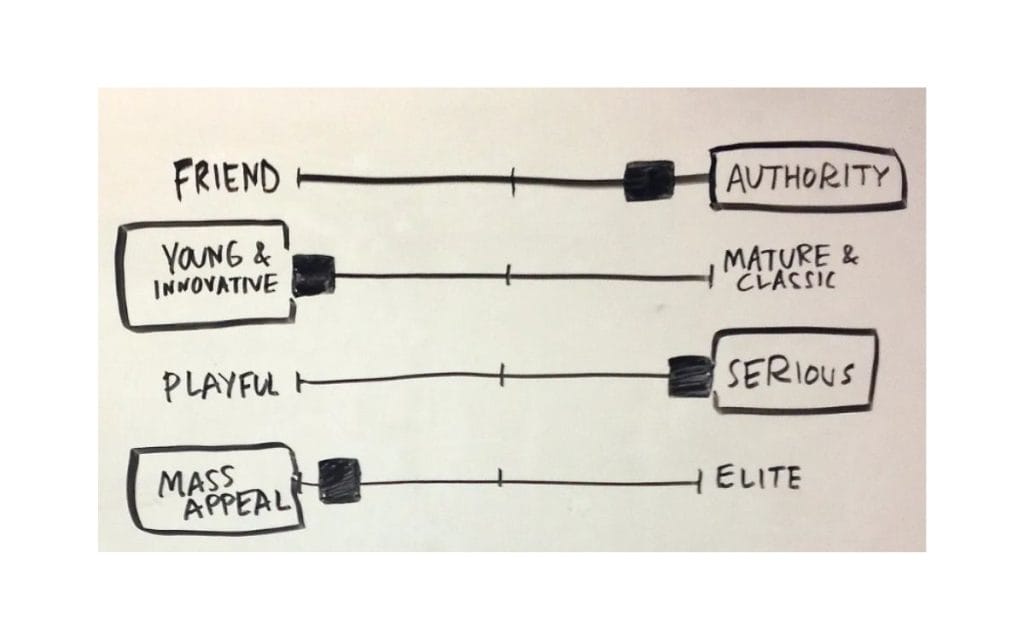
You can add levels to each direction – from 0 to 3 and pick other pairs of opposites that may be more relevant for your brand or your industry. When doing the exercise, try to position your brand as close to the extremes as possible. Staying in the middle on more than one scale will cause additional uncertainty later.
A variation of that exercise may include brand examples that help you align the meaning of each characteristic for everyone who takes part in the workshop. You can design one similar to what Google Ventures has developed in their Three-Hour Brand Sprint.
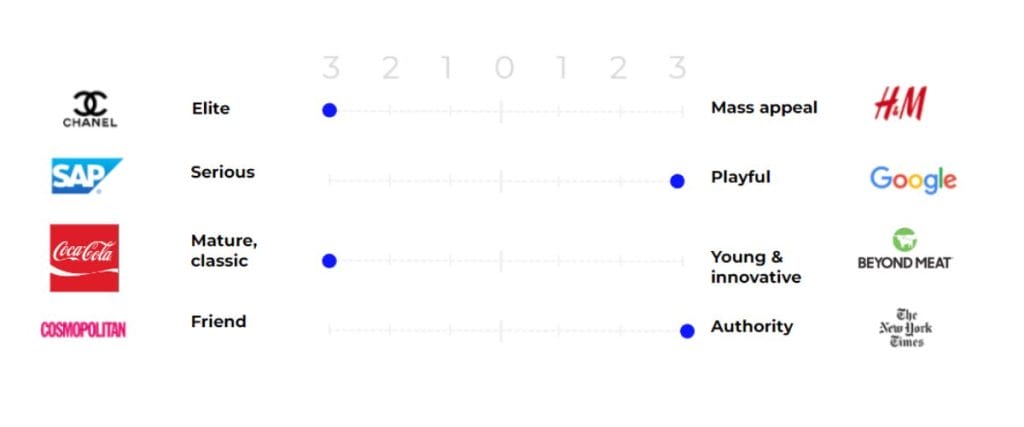
How to do the exercise:
- Print sliders for everyone and ask them to position your brand on their own.
- Give them 5 minutes and then invite them to put their choice on a white board.
- Discuss and decide what is the most precise for your brand. The most important part of the exercise is the discussion.
- If you cannot decide, it’s a good idea to have one person as a decision-maker. They listen to all the opinions but can make the final decision if there are options with an even number of votes.
- Document your choice in your TOV instructions document.
2. Add additional characteristics
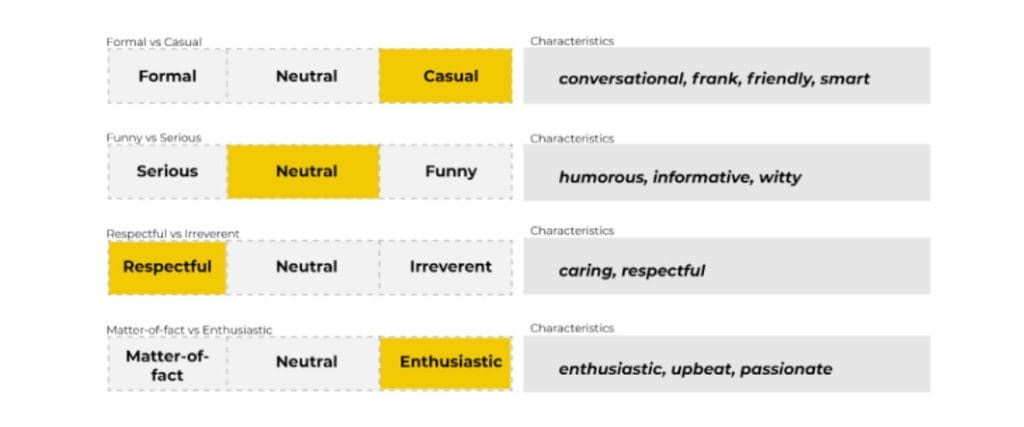
The second exercise is based on the Four Dimensions of Tone of voice developed by the Nielsen Norman Group. The four dimensions according to their method are:
- Formal vs. casual: Is the writing formal? Informal? Casual?
- Serious vs. funny: Is the writer trying to be humorous? Or is the subject approached in a serious way?
- Respectful vs. irreverent: Does the writer approach the subject in a respectful way? Or does she take an irreverent approach? An irreverent approach is often adopted by brands seeking to rebel and distinguish themselves from competitors. It typically doesn’t involve offensiveness toward the reader but rather challenges the subject.
- Matter-of-fact vs. enthusiastic: Does the writer convey enthusiasm for the subject? Does the organization express excitement about the service, product, or conveyed information, or is the writing characterized by a dry and matter-of-fact style?
Once we determine our position on each dimension—whether we lean towards one side or remain neutral—we can select from an array of additional words to enhance the specificity and distinctiveness of each dimension for our brand. Nielsen Norman Group’s team has compiled a list of adjectives for this exact purpose, and it can be expanded to suit our specific requirements.
I found an excellent example from Vassilena Valchanova in her article for Product Led, where she outlines the dimensions for her brand and includes additional characteristics for a dimension she set to neutral. As a professional addressing serious topics, she aims to avoid sounding funny; however, she skillfully incorporates occasional humor, maintaining a witty and informative tone simultaneously.
Some examples of brand TOV
There are fairly abundant examples online, but here are a few that I find clear and concise. This style guide was created for Mailchimp employees but they have generously shared it so other teams can use it too. It’s quite detailed and provides guidance.

Nike’s brand voice is a masterclass in targeted messaging. It’s positive and motivational, striking a chord with its core audience: the active individual. Their legendary “Just do it” tagline isn’t just catchy, it’s strategic. It’s concise, inspiring, and action-oriented, reflecting the brand’s focus on empowering people to achieve their athletic potential.

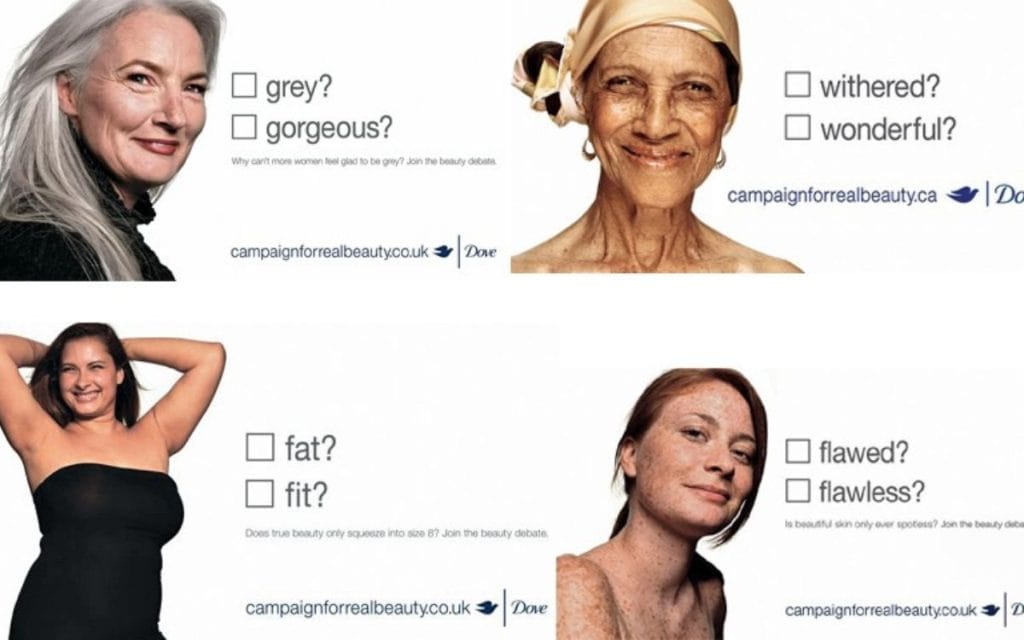
Dove’s brand voice isn’t just a tagline, it’s a movement. It’s an uplifting and empowering force that resonates deeply with its target audience, encouraging women to celebrate their unique beauty and embrace self-love. This messaging masterfully aligns with Dove’s core values of body positivity and female empowerment. Think about their campaigns: real women, diverse representations, and messages that challenge unrealistic beauty standards. It’s not just advertising, it’s a conversation, a community, and a powerful brand identity that seamlessly reinforces their product offerings.
How to apply TOV in your day-to-day work
Like other strategic documents, there is a risk that once discussed and created, it can end up collecting dust in your shared folder. So this is maybe the most important step in the process. The TOV document should serve as a framework that guides your teams across the business, ensuring consistency in all communications. It should serve as a practical manual and not a burden to your needs.
If you want your tone of voice to have an impact on your business, you need to involve the whole company. Beyond the marketing team, these rules for writing need to be embedded in the minds of everyone from HR to accounts, sales and support. That means getting people excited about your brand identity. It means making your brand voice a part of how your people live your values. Eventually, it will become second nature, but that won’t happen if you only send one mass email asking everyone to read a 20-page manual.
So here are some steps to guide you in the implementation.
1. Craft a brand voice chart and add it to your brand style guide. Add descriptions to each characteristic, provide examples, and include dos and don’ts. Here’s a great example from CoSchedule
Print the TOV manual with a user-friendly and appealing layout for your team to use. Make a short 1 pager as a poster for your office.
Include as many use cases as possible to explain the variations in tone for different situations and teams. Is it a delicate situation with money issues, or it’s something more joyful? Consider audiences from the perspective of various stakeholders, such as investors, customers, and team members. Sometimes it’s not right to speak to our investors the same way as we speak to our customers, there are certain situations when you may need a big tonal shift and that should be explained in the guide.
One question that frequently arises during discussions on tone of voice with my clients is whether the tone should vary across different channels, such as social media, websites, and others. While the typical approach might be to adjust the tone for LinkedIn compared to TikTok, I prefer to emphasize a shift in tone that aligns with the specific situation rather than the channel itself.
Considering that we naturally alter our voice when communicating with different audiences, it’s crucial to focus on the audience rather than focusing only on the channel. Sometimes, the overall audience of a channel may seem uniform, but within that broader audience, our target audience could be more specific. It’s essential to consider this nuance rather than relying solely on general channel audience statistics.
2. Organize workshops. It’s very hard to get commitment from an email conversation. Even a one-off group call isn’t going to cut it. We humans usually learn the best by doing. Experiential learning might be the best option here. Workshops are a great way to teach your employees the rules of your voice in a way that is both engaging and memorable.
Remember, a lot of your employees won’t be writers by default. Simply telling them to write in a way that is ‘open, honest and daring’ is next to meaningless for them. A workshop gives them a chance to try it out. As a starting point, set tasks that ask your people to assess their tone of voice as individuals. This is a great way to introduce the subject and get your people thinking about the importance of tone more broadly. From here, you can move into more relevant tasks that test their ability to write within the brand’s tone. These personalized learning experiences help to cement the most important elements of your tone in the minds of your people. Instead of being told what it sounds like, they’ve tried it for themselves and so are more likely to adopt it in their communications.
3. Appoint chief voice officer – to make sure you all keep to the same standard appoint a chief voice officer for the first few months. It may slow you down at first but the benefits come in the long run. This person can make revisions to communication or answer questions that your other team members may have. It’s important if they can work with everyone who is creating content and with your customer service team. Sometimes a discussion about a certain word or phrase may take up to half an hour and that’s completely normal and you have to get used to such discussions because they help everyone get a clearer picture of the brand voice.
If you’ve come this far, I hope that this article will give you a good idea of the steps you can take to craft your brand’s tone of voice. I realize it may sound complex and confusing because the process is time-consuming, involves trial and error and coordination of many people. That’s where I can help you and simplify it as well as save you time with the structured process I have developed in my work with clients. I’ll be happy to guide you in this creative process so we can enable your team to communicate more effectively and help them understand your distinctive identity and truly live your brand values. Just give me a call and let’s discuss how to develop your distinct tone of voice.

